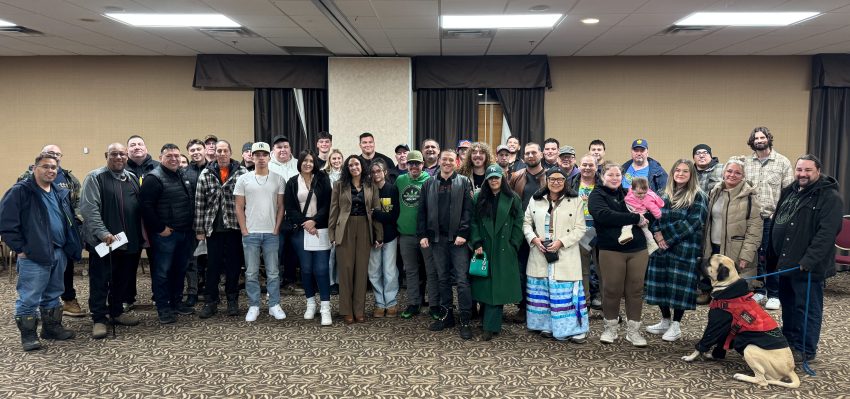
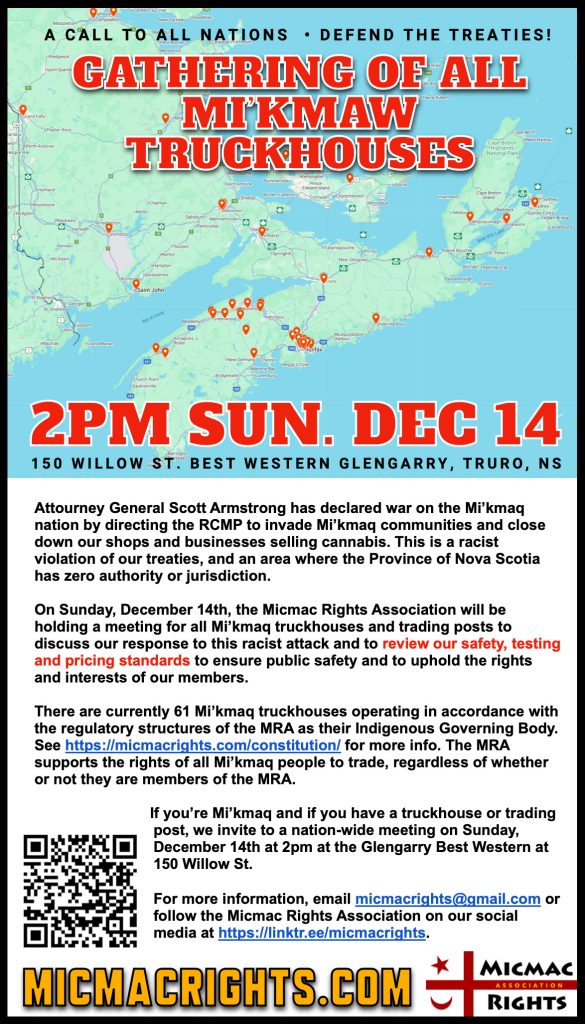
TRURO, N.S. – Over 60 members of the Micmac Rights Association (MRA) packed a conference hall in Truro on Sunday, December 14, 2025 for a meeting addressing what many participants described as a provincial “declaration of war” on Mi’kmaq treaty rights. The meeting brought together owners and representatives of Mi’kmaq truckhouses and trading posts from across Mi’kma’ki, to discuss the Province of Nova Scotia’s unlawful directive requesting that the RCMP close Mi’kmaq-owned cannabis shops operating under treaty authority on and off reserve.
The gathering followed public statements made by Attorney General Scott Armstrong on Dec 4th, 2025. Armstrong unlawfully called for enforcement actions against Mi’kmaq truckhouses across the province. Armstrong’s comments revealed his ignorance of Canadian constitutional law, as the province, under the BNA Act, has no constitutional authority for “Indians or lands reserved for Indians” and thus cannot over-rule any Aboriginal or treaty rights.
Armstrong’s press conference prompted strong criticism from Mi’kmaq leaders and business owners, who argue that the Province lacks constitutional authority over Mi’kmaq trade, and that Armstrong’s direction violates long-recognized treaty rights. The MRA responded to Armstrong with a statement on December 5th, emphasizing that the Attorney General – a school teacher and not a lawyer – “does not appear to understand Canadian law or the authority and jurisdiction attached to his office.”

Participants at the meeting described the government’s position as discriminatory and racist, asserting that Mi’kmaq people have the constitutional and treaty-protected right to operate independent trading posts. Many attendees said that Armstrong’s comments demonstrated a lack of understanding of Canadian law, Mi’kmaq governance, and the Treaty of 1752, which affirms Mi’kmaq rights to trade freely within the province.
“The Attorney General’s statements are systemic racism,” one participant said. “He has no education in law yet is directing the RCMP to intervene in matters far outside provincial authority. Mi’kmaq have our own governance systems and our own laws rooted in the treaties.” Indeed, the MRA has been regulating the operation of Mi’kmaw truckhouses through its own community safety standards for several years. This self-regulation has been communicated to the province in letters sent on July 31, 2024, September 16, 2024, and July 3, 2025.
The most recent MRA meeting, held at the Glengarry Best Western in Truro, served both as an emergency response session and as a continuation of ongoing efforts to build a self-regulated Mi’kmaq economy. The Association reaffirmed its role as an Indigenous governing body focused on traditional principles of self-determination, community safety, and responsible trade.
Concerns Over Jurisdiction and Treaty Rights
Speakers emphasized that the province of Nova Scotia has no jurisdiction to regulate Mi’kmaq treaty-protected economic activity. The Mi’kmaq treaty relationship, they noted, is with the Crown, not the provincial government which is merely an administrative department of Canada that explicitly has no jurisdiction over “Indians or lands reserved for Indians.” Several participants expressed concern that recent statements from provincial officials signal a broader pattern of ignoring constitutionally protected Indigenous rights.
“There has never been meaningful consultation around cannabis,” another participant said. “The Province continues to legislate and make decisions that affect Mi’kmaq people without involving us. New legislation is even diluting definitions of who is Mi’kmaw. It’s another attempt to control us rather than recognize our sovereignty.”
Some members drew parallels between current government actions and historical policies aimed at undermining Indigenous autonomy. One speaker compared Armstrong’s statements to those of Duncan Campbell Scott, the federal bureaucrat associated with assimilationist policies in the early 20th century. “This is the same kind of thinking – trying to remove Indigenous rights by force or by policy,” the speaker said.
Others raised concerns about the increasing pressure on band councils and provincial Indigenous organizations that, in their view, do not reflect the will of grassroots Mi’kmaq people. “If chief and council leadership aren’t aligned with rights, oppression will continue,” a store owner said. “We need to build our own economies and chart our own future.”
Safety Standards and Self-Regulation
In addition to the political discussions held at the meeting, the MRA conducted a review of its safety and testing standards for Mi’kmaq cannabis products. Contrary to claims made by the province, the Association maintains a community-based regulatory framework that includes product testing, labeling guidelines, and quality assurance measures. Members said that strengthening these internal safeguards is a key part of demonstrating their sovereignty.
“Our communities take safety seriously,” one participant noted. “We are committed to testing, proper packaging, and fair pricing. The Province is trying to lump us in with black market operations, but our testing and standards are designed to protect the people, and we have currently 67 shops operating under these procedures.”
Participants also pointed to what they described as double standards in provincial messaging about cannabis. They noted that after Premier Tim Houston made baseless lies linking Mi’kmaq cannabis is linked to deadly fentanyl – claims that have not been substantiated in any way, and which were in fact were in fact denied by the RCMP – two Mi’kmaq cabins on Hunter’s Mountain were burned down the following day. “These kinds of statements are racist dog whistles and incitements to violence” MRA Legal Council Tuma Wilson said.
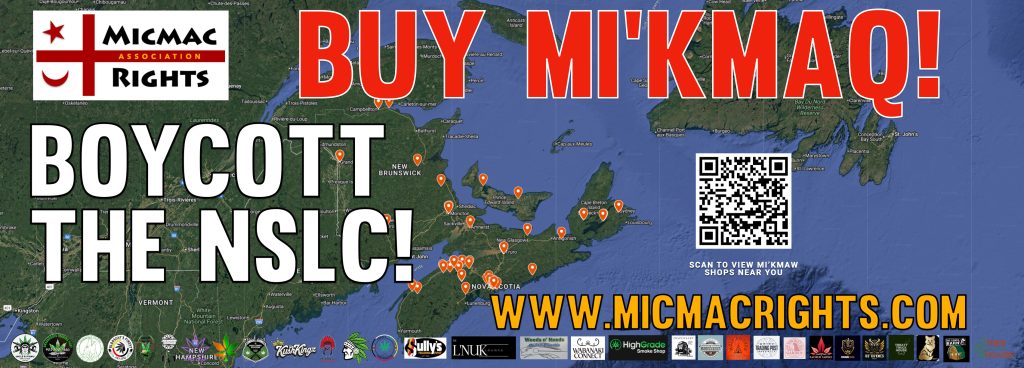
Several participants contrasted Mi’kmaq-run cannabis stores with the Nova Scotia Liquor Corporation, arguing that NSLC locations bring harmful substances such as alcohol into Indigenous communities. “We do not need alcohol on reserve,” one shop owner said. “It has caused enough damage already.”
Media, Misinformation, and Public Perception
A number of MRA members expressed concern about how Indigenous people and Mi’kmaq cannabis businesses are being portrayed in the media. Some said they believe that coordinated misinformation campaigns are aimed at shaping public opinion and delegitimizing Indigenous rights.
“There is a big media push against us,” one participant argued. “We need to humanize ourselves and tell our own stories. When people know who we are and what we do for our communities, it becomes harder to demonize us.”
Truckhouse operators highlighted the charitable contributions many of them make to local families, events, and community programs – often without public recognition. Members suggested increasing the visibility of these contributions to counter negative stereotypes.
A Call for Unity and Self-Determination
The meeting concluded with a strong call for unity among Mi’kmaq people and the discussion of an Action plan to co-ordinate responses to any future RCMP raids. Many participants emphasized the importance of building a Mi’kmaq-controlled economy as the foundation for true self-government.
“We cannot govern ourselves without an economy,” one speaker said. “The government wants to end the Indian Act and assimilate us. We must stand together, protect our rights, and not be afraid.”
Participants expressed confidence that the Mi’kmaq Nation, grounded in treaty rights and traditional governance, will prevail in the current conflict. “We are the seventh generation. Our ancestors stand with us. If we stay united, we will make history – not just for Mi’kma’ki, but across all of Canada.”