

Michael Gorman · CBC News · Original Article
Opposition politicians say it is up to Nova Scotia Premier Tim Houston to find a way to lower tensions between his government and Mi’kmaw leadership in the province.
“The premier has to pick up the phone, he has to reach out to the chiefs,” Liberal MLA Derek Mombourquette told reporters Thursday.
“He has to get around the table and they need to start repairing that relationship.”
Chiefs have expressed concern this year about the Progressive Conservative government making decisions that could affect them without including them in talks ahead of time. That’s included legislation that reversed bans on uranium exploration and mining and rules aimed at protests on Crown land that block logging operations.
Most recently, the chiefs criticized the government for a news conference last week where Justice Minister Scott Armstrong said he was calling on the RCMP to take on cannabis sales at sites outside the provincially regulated system. Some of those sites are located on First Nation reserves.
Government ‘creating an enemy’
Armstrong sent a letter to chiefs outlining the government’s position on the same day as the news conference. The chiefs have said they were not previously consulted and noted that they pushed in the past to be included in the legalization framework without any response from former governments. They’ve accused the government of targeting First Nation communities.
NDP Leader Claudia Chender agreed with that assessment.
“I think we see this government creating an enemy out of the Mi’kmaw people in this province when what they should be doing is working collaboratively with them,” she told reporters.
Houston was unfazed by the pushback, which has included at least one First Nation banning him from their community.
He said the issue is about public safety and concerns that cannabis sold outside the Health Canada-approved system using Nova Scotia Liquor Corporation outlets opens the door to tainted supply and organized crime. Arrests at illicit sites have produced weapons and other drugs, the premier noted.
“We’re just saying let’s treat weed like we treat booze,” he told reporters following a cabinet meeting Thursday.
Armstrong has said the government would be willing to set up NSLC sites in First Nation communities to ensure a safe supply that cuts out the illicit market, while pledging to leave all proceeds in the host communities.
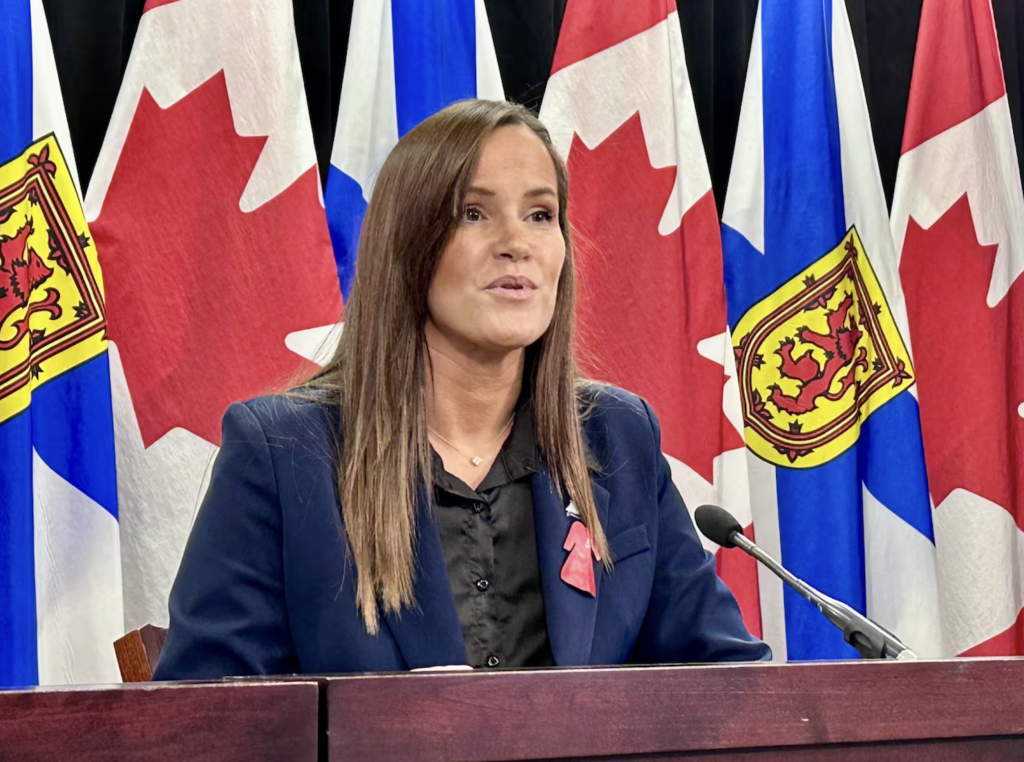
The premier said he’s heard from people in First Nation communities in the last week who welcomed the government’s announcement because they don’t like the proliferation of unauthorized sites and the problems they can bring.
Houston said he has a good relationship with many of the chiefs and the government always adheres to its legal duty to consult. When it comes to talking with the chiefs, Houston said he’s “an open door.”
But as tensions have increased, some chiefs have called for the resignation of L’nu Affairs Minister Leah Martin. Andrea Paul, Nova Scotia’s regional chief for the Assembly of First Nations, recently posted on social media that Martin — who is Mi’kmaw — “is not serving the Mi’kmaq in a way that upholds our values or our collective wellbeing.”
Martin, who said she stands by the approach Armstrong used last week, downplayed the calls for her resignation.
“There’ll be times where we disagree, and that’s OK,” she told reporters.
The minister said she is “an open door” and the chiefs know they can contact her. She said her job is to “communicate across the gap” between communities and the government.
‘Business as usual’ for RCMP
Meanwhile, Nova Scotia RCMP say they have no plans to change their approach to illegal cannabis dispensaries, despite the provincial government’s directive.
A spokesperson for the Nova Scotia RCMP says they’re already enforcing existing laws.
Cst. Mandy Edwards made the comments in an interview with The Canadian Press a few days after Armstrong issued the directive to the RCMP and other police forces.
The directive instructs police to focus on intelligence collection, identify and disrupt illegal cannabis operations and distribution networks and report “enforcement outcomes” back to the province.
Edwards says things are “business as usual” at the Nova Scotia RCMP, and they will continue with their ongoing efforts to tackle illegal cannabis and other illegal substances.