November 14, 2026
To the members of Glooscap First Nation,
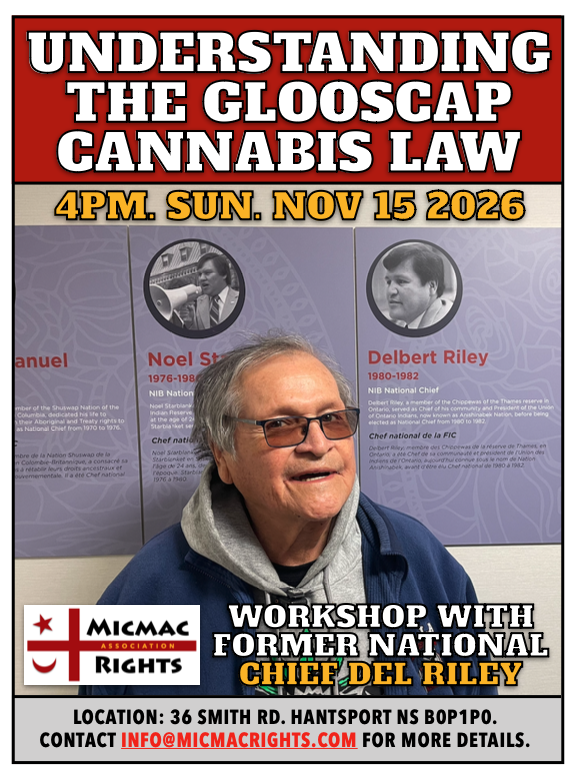
We would like to thank the Chief and Council of Glooscap First Nation or whoever wrote the November 12th letter on their behalf, for their promotion of our workshop on the proposed GFN Cannabis and Tobacco bylaw at 4 PM on Sunday, November 15 at 36 Smith Road in Glooscap.
However, there are a number of errors and misconceptions with the GFN letter and its purported “facts” that we wish to address.
Firstly, we want to be clear that the MRA does not claim to speak for the Indian Act entity known as Glooscap First Nation. We act on behalf of our members, some of whom are Indians registered to Indian Act Band number 030 on reserve Glooscap No. 35, and thereby electors of the council of the band of Glooscap First Nation.
Our members are Mi’kmaq people who agree with our constitution and who wish to advocate and collectively assert our people’s inherent aboriginal and treaty rights. Unlike the GFN, whose existence, authority, and jurisdiction is determined by the racist and colonial Indian Act, the MRA operates by consensus to advocate for our rights in accordance with Mi’kmaq custom and convention.
The GFN Letter erroneously identifies former National Chief Delbert Riley as the “leader“ of the MRA. This is not correct. Chief Riley, the author and lead negotiator of Sections 25 and 35 of the Canadian Constitution Act is not the “leader“ of the Micmac Rights Association. He is an honoured elder and advisor of the MRA, who we hold in great esteem, but he is not a member or leader of the MRA, as he is not Mi’kmaq.
The GFN states that the MRA’s analysis “was not prepared by anyone with legal credentials in Indigenous law or Canadian law.” This is an interesting statement, as Chief Riley has been a lifelong hereditary Chief under the Indigenous law of the Chippewa Nation. Chief Riley has been fighting the Canadian legal system since he was abducted by the RCMP and forced into residential school at the age of 6 years old – over 75 years ago.
As a hereditary leader, an elected Band Councillor, an elected Chief, an Ontario Regional Chief, and as the last President of the National Indian Brotherhood, Chief Riley has spent over 6 decades engaging with the Canadian legal system. As an Indigenous leader, he hired many lawyers, including some who went on to serve on Canada’s Supreme Court.
Let’s remember that when our Mi’kmaw ancestors negotiated and executed our treaties with the Crown, they did so without any lawyers. Our leaders did a great job protecting our rights – rights that the Canadian Courts have been required to uphold.
But the real issue is not about lawyers and legal credentials. It is about what the Glooscap Cannabis and Tobacco Bylaw actually says. Chief Riley, one of the most accomplished and well informed Indigenous elders alive in Canada today, provided us with over 4500 words analyzing the law. The GFN response letter does not provide a single substantive response to any of Chief Riley’s analysis.
The GFN letter claims that the MRA‘s position is that “cannabis should be grown and sold on reserve by individuals, outside any community rules.” This is untrue and a complete distortion of the MRA position which has been developed in a number of position papers on the matter and is even written into our constitution.
The MRA doesn’t say that there shouldn’t be any rules, just that those rules should be consistent with the inherent Aboriginal and treaty rights of the Mi’kmaq people and that individual Mi’kmaw people have a right to cultivate, and sell and trade and earn a livelihood from cannabis on the entirety of our unceded lands in Mi’kmaw’ki. The MRA has a set of “community standards” that all members are required to follow, and a process of self regulation for the industry.
GFN’s claim that MRA members provide nothing to Glooscap First Nation is contradicted by the generosity and support that MRA members have provided to people of GFN, even though the council of the band has refused to accept formal donations from the cannabis businesses in the community.
The GFN letter complains that the workshop is being held at a “private cannabis store.” This is incorrect. The members of GFN who are organizing this event attempted to book the band hall, but were never responded to. Unable to secure a location through GFN, they are instead meeting at a community home at 36 Smith Road.
The meeting location is not a cannabis store but an adjacent room in the building which is available for meeting. Either way, if this is an issue, we will happily hold a follow-up meeting to this event in the band hall, as soon as the band confirms that it will let the MRA use the space to hold such a meeting.
The GFN letter also defames the MRA by claiming that “individuals” on the MRA board were involved in group chats containing derogatory and misogynistic comments about Mi’kmaw women.” First of all, there were no “individuals” from the MRA in such chats. There was one person in that chat who was a member of the MRA, and that person immediately resigned from the organization when news of his misconduct surfaced.
As for the claim that we impugn the integrity of Chief and council by comparing GFN to a “concentration camp,” please note that is not what Chief Riley said. He wrote: “From a sovereign Indigenous perspective, confusing an Indian Act Band Council with a nation, is kind of like the prisoners of a concentration camp being allowed by their captors to elect representatives to speak on their behalf and be responsible for the running of a set of narrow and limited services for the camp prisoners, and then conflating those people with the national leadership of their nation.”
The fact that an Indian Act band council is closer to an elected prisoner committee in a concentration camp than an actual nation is self-evident. The further fact that Canada’s Indian Act was an inspiration to Apartheid South Africa, and to Adolph Hitler’s racial laws in Germany should help to drive the point home.
Nowhere in the GFN letter are the actual issues raised by Chief Riley addressed. Instead, there is an empty appeal to authority that the GFN cannabis and Tobacco bylaw was “guided“ by legal counsel at every stage.
Regardless of the involvement of legal council, the proposed Glooscap Cannabis and Tobacco bylaw doesn’t follow Mi’kmaq rights, customs, and conventions, and serves the Federal Government (the Indian Act Band Council) by bringing taxation onto reserve and taking away from the rights actually being practiced by GFN band members.
Your letter claims that your law “protects the nation“. It does nothing of the sort. It undermines our nation, and it empowers a small clique who is running the Indian Act system and benefiting from the corporate monopoly they are building on reserve.
To conclude, we look forward to continuing these discussions with Chief Riley and members of Glooscap First Nation at his upcoming workshop. We invite GFN members to join our rights association so we can work together to strengthen and empower our people. We encourage the leadership of GFN to actual respond to the substance of Chief Riley’s critique rather than make wild and inaccurate accusations that have no bearing on the matters and hand. We look forwards to hearing from you.
On behalf of the Micmac Rights Association,
Chris Googoo, Clinton Ray Howard, Thomas Durfee, Brandon Dorey, Brian Dorey and Chris Labillois.