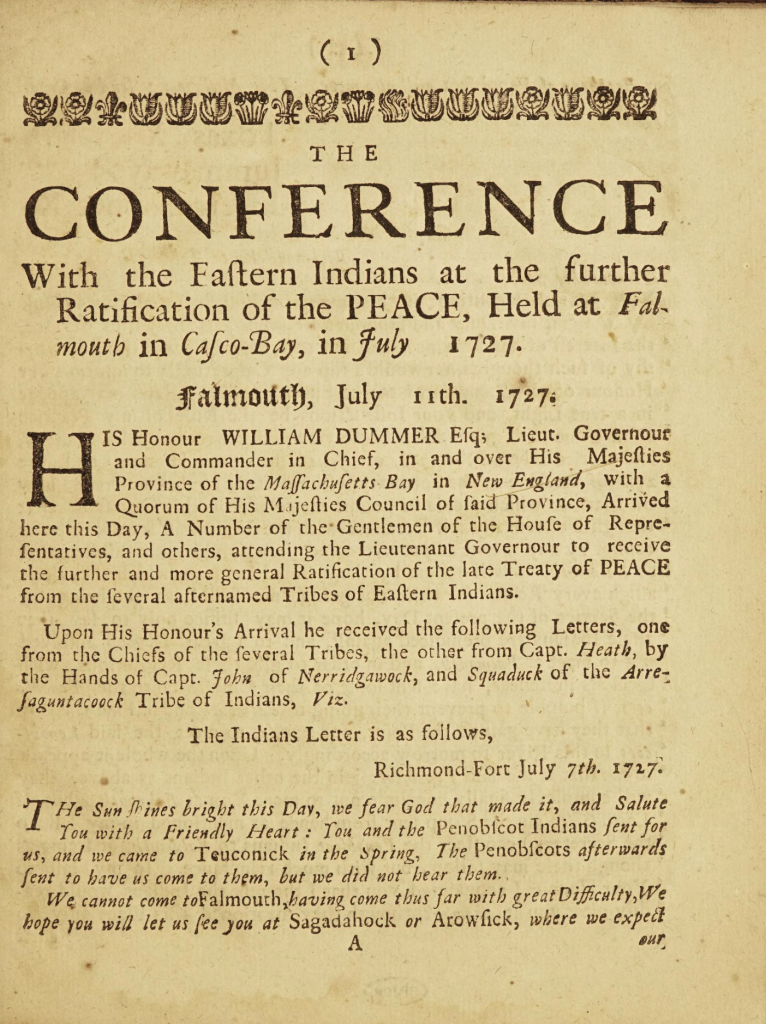
The “Peace and Friendship Treaties” were negotiated with a broader Wabanaki Confederacy alliance – Mi’kmaq, Wolastoqiyik (Maliseet), Passamaquoddy, Penobscot, and Abenaki/Norridgewock – not with the Mi’kmaq alone. Some entries below (1725, 1727, 1754) are technically ratifications by Penobscot, Norridgewock, or St. John’s (Maliseet) delegates rather than Mi’kmaq delegates specifically. Most originals and transcripts are held by Nova Scotia Archives, whose central hub for these documents is here: Nova Scotia Archives – Peace and Friendship Treaties.
1. Treaty of Boston (Articles of Submission and Agreement) – 15 December 1725
Signed at Boston by J. Willard (Secretary, Massachusetts General Court) and delegates of the Penobscot, Norridgewock, St. John’s (Maliseet), and Cape Sable (Mi’kmaq) – ending Father Rale’s War. This is the founding document of the whole treaty series; it explicitly required ratification at Annapolis Royal (below) to bind the Mi’kmaq and Nova Scotia peoples.
- Full transcribed text: johnwood1946.wordpress.com – “First Document: The Treaty of December 15, 1725”
- Archives record: Nova Scotia Archives, Treaty of 1725 for Ratification at Annapolis Royal
2. Ratification at Annapolis Royal (“Articles of Peace and Agreement” + “Reciprocal Promises”) – 4 June 1726
The actual Mi’kmaq/Maliseet/Passamaquoddy ratification – 77 Indigenous delegates signed the Articles of Peace and Agreement; Lieutenant-Governor Lawrence Armstrong and Captain John Doucett signed the reciprocal British promises. Often called Mascarene’s Treaty.
- Full transcribed text (Doucett’s Reciprocal Promises): johnwood1946.wordpress.com – “Second Document: The ‘Reciprocal Promises’ of June 4, 1726”
- Context/summary: RCAANC – Fact Sheet on Peace and Friendship Treaties
- Background: Wikipedia – Peace and Friendship Treaties
3. Ratification at Casco Bay – 25 July 1727
Signed near present-day Portland, Maine, by the Lieutenant Governors of New Hampshire and Massachusetts Bay, Paul Mascarene (for Nova Scotia), and representatives of the Arresaguntacook, Wawenock, Norridgewock, and Penobscot. Not a Mi’kmaq signing, but part of the same treaty family and referenced in later Mi’kmaq treaty renewals.
- Archives record/transcript: Nova Scotia Archives – Peace and Friendship Treaties hub (search “1727 Ratification at Casco Bay”)
4. Ratification at Annapolis Royal – 13 May 1728
Signed by “Chiefs & others of the St. Johns, Cape Sables & other Tribes… inhabiting Nova Scotia or Acadie” – this one does include Cape Sable Mi’kmaq signatories. Written on the reverse of the original 1725 treaty document.
- Archives record: Nova Scotia Archives – Peace and Friendship Treaties hub (search “1728 Ratification at Annapolis Royal”)
5. Renewal at Chebucto – 15 August 1749
Signed aboard HMS Beaufort in Halifax Harbour, renewing the 1725/26 treaty in the wake of the founding of Halifax. Signed by Joannes Pedousaghtigh (“Chief of the Tribe of Chignecto Indians”) and deputies from the St. John’s (Maliseet) chiefs.
- Archives record/transcript: Nova Scotia Archives – Peace and Friendship Treaties hub (search “1749 Renewal at Chebucto”)
6. Ratification at St. John – 4 September 1749
Signed on the reverse of the Chebucto renewal by the chief and representatives of the St. John’s River communities (Maliseet).
- Archives record: Nova Scotia Archives – Peace and Friendship Treaties hub (search “1749 Ratification at St. John”)
7. Treaty of 1752 – 22 November 1752
Signed at Halifax between Governor Peregrine Thomas Hopson and Major Jean-Baptiste Cope, “Chief Sachem of the Tribe of the MickMack Indians inhabiting the Eastern Coast,” with delegates Andrew Hadley Martin, Gabriel Martin, and Francis Jeremiah. This is the treaty at issue in R. v. Simon (1985) and famously renounced by Cope himself six months after signing.
- Full transcribed text: Cape Breton University – Treaty of 1752
- Archives transcript: Nova Scotia Archives, ID=623 – Treaty of 1752 transcript
- Background: Wikipedia – Treaty of 1752
8. Ratification by the Norridgewolk – 2 July 1754
Signed at Falmouth, Casco Bay (Maine) – Abenaki/Norridgewock, not Mi’kmaq, but part of the same renewal cycle of the 1725 treaty.
- Archives record: Nova Scotia Archives – Peace and Friendship Treaties hub (search “1754 Ratification by the Norridgewolk”)
9. Ratification by the Penobscot – 6 July 1754
Signed at Falmouth, Casco Bay – Penobscot, not Mi’kmaq.
- Archives record: Nova Scotia Archives – Peace and Friendship Treaties hub (search “1754 Ratification by the Penobscot”)
10. Treaty of Peace and Friendship with Paul Laurent (LaHave) – March 1760
Signed at Halifax by Governor Charles Lawrence and Paul Laurent, Chief of the LaHave Mi’kmaq – the first of the “Halifax Treaties” and the one containing the “trade clause” central to the 1999 R. v. Marshall decision.
- Key clause quoted in: Lexology – The pursuit of peace and friendship in Mi’kma’ki: the legacy of the Marshall decisions
- Archives record: Nova Scotia Archives – Peace and Friendship Treaties hub (search “Treaty of Peace and Friendship… Paul Laurent”)
- Background: Wikipedia – Halifax Treaties
11. The Halifax Treaties – 1760–1761
A series of individual, nearly identical treaties signed through this period between Governor Charles Lawrence (and, after his death, Jonathan Belcher) and the chiefs of separate Mi’kmaq districts (Chignecto, Miramichi, Shubenacadie, Richibucto, Pictou, and others), plus the Maliseet and Passamaquoddy. These are the treaties underlying the 1999 Marshall decision’s “moderate livelihood” ruling.
- Overview: L’nuey – Peace & Friendship Treaties
- Research paper with chief-by-chief detail: L’nuey – Treaties of Peace and Friendship (PDF)
12. Treaty of Peace and Friendship with Francis Muis (LaHave) – 9 November 1761
Signed at Halifax by Jonathan Belcher (President of Council) and Francis Muis, Chief of the LaHave, witnessed by the missionary Pierre Maillard.
- Archives record: Nova Scotia Archives – Peace and Friendship Treaties hub (search “Belcher and Francis Muis”)
13. The Royal Proclamation of 1763 – 7 October 1763
Not a Mi’kmaq-specific treaty, but a Crown proclamation recognizing Indigenous title to unceded land and reserving land negotiation to the Crown; it frames all subsequent treaty and land relationships and is treated as part of this constitutional record.
14. Treaty of Windsor – 22 September 1779
The last major treaty negotiation in this series: signed at Windsor, NS, between Michael Francklin (King’s Superintendent of Indian Affairs) and John Julien, Chief, together with representatives from Miramichi, Pogmousche, Restigouche, Richibucto, and Shediac – effectively a ratification by the Mi’kmaq of Cape Tormentine to the Bay of Chaleur of the terms of the earlier treaties.
- Archives record: Nova Scotia Archives – Peace and Friendship Treaties hub (search “Treaty of 1779… Windsor”)
- Context: Library and Archives Canada – Treaties, Surrenders and Agreements essay