
Indigenous affairs minister says he wants to find ways to integrate First Nation pot sales into the provincial system
From The Telegraph-Journal by John Chilibek Local Journalism Initiative May 13 2026
It turns out more than one provincial cabinet minister recently toured a First Nation pot facility that would eventually be raided by the RCMP.
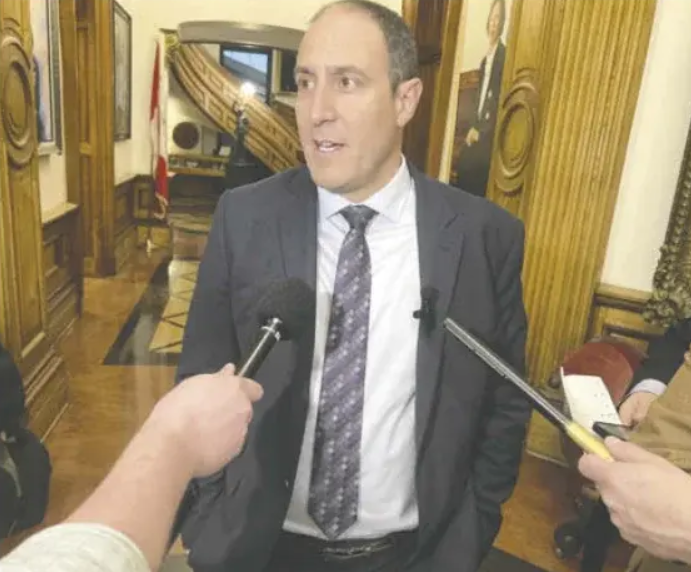
Keith Chiasson, the minister of Indigenous affairs, told reporters at the legislature on Friday that he too was on the tour of Madawaska Warehouse, alongside Luke Randall, the minister responsible for Cannabis NB, on March 30.
Only 27 days later, on April 26, the warehouse was raided by the RCMP, one of six locations in the First Nation, Nova Scotia and Ontario where the police force executed search warrants. They say they were targeting organized crime, drug trafficking, and money laundering. As of Friday, no charges had been laid.
“I was there, yeah,” Chiasson said about his cannabis tour inside the First Nation. “It was just part of a visit like we’ve done to every First Nation community in the province. There was nothing out of the ordinary with the visit because I visited every single First Nation community.”
But there was one big difference. The minister acknowledged that it was the first time a couple of cabinet ministers toured pot facilities in a First Nation to learn about how the recreational drug market worked outside of the provincially sanctioned Cannabis NB stores.
Randall also admitted to Brunswick News last week he had toured the private cannabis wholesaler along with a few pot shops in Madawaska First Nation on that day. He said several government officials were in tow, without mentioning another minister was with him.
Chiasson said they went on the tour in the Indigenous community beside Edmundston after Madawaska Chief Patricia Bernard invited them to take a closer look at how her community handles the recreational pot trade.
In 2023, the First Nation passed its own law regulating cannabis and tobacco sales.
However, such legislation isn’t granted explicit permission in the federal Cannabis Act and hasn’t been tested in court.
The raid targeted the business of Cindy Bernard, who is the chief’s niece and the daughter of John Bernard, the successful owner of the Grey Rock casino and various other enterprises. He had rented the warehouse to his daughter and condemned the raid as baseless and traumatizing, arguing that organized crime had nothing to do with the business.
His daughter, he said, was arrested at her home at four in the morning in front of her two young children. She was released the same day.
The Liberal government’s back-channel negotiations with First Nations on cannabis hadn’t been made public until Brunswick News reported on the raid and its aftermath.
“Our government’s approach is working with First Nations,” Chiasson said. “Our government wants to have those discussions and build a path that brings in safe, regulated cannabis to all people in New Brunswick.”
Chiasson said the collaboration started in earnest about six months ago, after his Liberal government successfully negotiated new tax sharing agreements with the province’s 15 First Nations that the previous Progressive Conservative administration had refused to renew.
The cabinet ministers apparently knew nothing about the impending raids. Public Safety Minister Robert Gauvin has declined comment, citing the police investigation. Chief Bernard has turned down interview requests for the same reason.
New Brunswick’s Liberal government has not followed the same path as Nova Scotia’s Progressive Conservative administration on the issue.
In the Blue Nose province, Premier Tim Houston led a crackdown on First Nations cannabis shops, arguing they were illegal and unsafe, especially for children. The RCMP’s enforcement measures have led to confrontation, blockades and violence in some Mi’kmaq communities.
New Brunswick has taken a softer approach.
“Discussions are just started,” Chiasson said. “We’ve just, really, over the last six months, started to talk about cannabis. And it’s different from one community to another, on the approach that they want to take. Some are looking at the model of Cannabis NB. Some are looking at creating regulations themselves.”
Chiasson added that he didn’t think the two sides would settle on a one-size-fits-all model. Like Randall, the Indigenous affairs minister said the federal cannabis law was making any kind of deal difficult. Health Canada is tasked with ensuring suppliers are on an approved list, but smaller growers often don’t want to deal with the bureaucracy because it’s expensive.
“We leave those discussions up to First Nations and their federal government. For us, really, it’s about bringing in safe product and making sure that it’s, you know, from a reliable source.”
Like Randall, Chiasson wouldn’t comment on the RCMP investigation.
The leader of the small opposition Green Party said New Brunswick’s government was taking a better approach than Nova Scotia’s.
“It’s better to talk than fight,” David Coon said. “Talking is good, as long as that resolves the problem, and we get a good solution that everyone is comfortable with. I see no reason why we can’t get there.”
But he also said organized crime was a big problem and couldn’t be ignored, having read the RCMP’s annual reports.
He said just like most people, he had no idea if Madawaska Warehouse had ties to the criminal underworld.
“We don’t have a big enough press corps anymore, in the province, like they do in Quebec, where you have organized crime reporters,” Coon said.
“Just reading the annual reports coming out of the RCMP, they’re saying they’re particularly concerned because of the influence organized crime has on public servants, on unelected officials. And organized crime looks to find people they can rely on inside politics, inside the public service.”
Coon said the situation was very worrisome considering organized criminals are involved in pushing dangerous street drugs, human trafficking and murder.
He brought up the killings of Bernard, 78, and Rose-Marie Saulnier, 74, in their Dieppe home in 2019. Janson Baker, acting on the instructions of drug dealers who wanted their son dead, was sentenced to life in prison on Thursday for the first-degree murders.
“We need to ensure that there’s a full court press to tackle organized crimes in New Brunswick,” the politician said. “In this province, it’s not talked about enough. The minister of public safety rarely speaks to it.”